by Wavefront Software
In today’s laboratories, data is both your most valuable asset and your biggest operational challenge.
As sample volumes increase and regulatory demands grow, manual processes like spreadsheets quickly become a bottleneck.
Understanding the benefits of LIMS is key to overcoming these challenges. A modern Laboratory Information Management System (LIMS) helps laboratories streamline workflows, reduce errors, and turn data into a true operational advantage.
The Problem: Why Excel is Holding You Back
For many laboratories, the tipping point comes when Excel is no longer enough. What once worked for small volumes becomes fragile at scale.
Version control issues, manual data entry, and disconnected files create a hidden layer of inefficiency.
Teams spend valuable time fixing errors, searching for data, and rebuilding reports. This “hidden factory” of rework slows down your lab without being immediately visible.
The Risks of Manual Systems

- Lack of Traceability: Who changed that result? When? Why? Excel rarely tells you.
- Data Silos: Results sit on local hard drives rather than a centralized database, making trend analysis impossible.
- Transcription Errors: Studies suggest that manual data entry has an error rate of roughly 1%. In a lab processing thousands of samples, this equates to dozens of incorrect reports annually.
One of the core benefits of LIMS is eliminating these risks by acting as a single source of truth.
Not sure if your lab is ready for a LIMS? Download our LIMS Requirements Checklist to evaluate your current workflows.
Core Operational Benefits of LIMS
The primary benefits of a LIMS are operational. By introducing automation, structure, and real-time visibility, a LIMS removes inefficiencies from daily laboratory work and allows teams to focus on higher-value activities.
1. Automating Workflow and Reducing Errors
One of the most immediate benefits of LIMS is reducing manual errors through automation. Instead of relying on technicians to manually enter and calculate results, a LIMS integrates directly with laboratory instruments to capture raw data automatically.
The system applies validated calculations and compares results against predefined specifications.
For example, in a lab processing hundreds of samples per day, manual data entry can introduce transcription errors or missed quality checks.
With a LIMS in place, the system enforces Standard Operating Procedures (SOPs), prevents incomplete workflows, and flags out-of-spec results in real time.
This improves data accuracy, reduces error rates, and eliminates the need for time-consuming rework and investigations.
2. Streamlining Laboratory Operations
Efficiency in a laboratory is driven by visibility and flow. A LIMS provides real-time dashboards that allow lab managers to track every sample throughout its lifecycle—from login and preparation to testing and final review.
Instead of physically chasing samples or relying on spreadsheets and status updates, teams can identify bottlenecks immediately. For instance, if a specific instrument or department is experiencing a backlog, managers can quickly reallocate resources to keep operations moving.
This level of visibility reduces turnaround delays, improves overall lab throughput, and enables teams to handle higher sample volumes without increasing headcount.
3. Automated Reporting
In many laboratories, the biggest bottleneck is not testing—it is reporting. Generating Certificates of Analysis (COAs) or final reports often involves manually compiling data from multiple sources, which is both time-consuming and prone to errors.
A LIMS automates this entire process through its reporting capabilities.
Laboratories can generate standardized, client-ready reports instantly without manual data consolidation.
Data flows directly from instruments and workflows into pre-configured report templates.
This ensures consistency and accuracy every time.
For example, what may take a technician 10–15 minutes per report manually can be reduced to seconds with automation. Across hundreds of samples, this results in substantial time savings and significantly faster turnaround times for customers.
The Financial Argument: Calculating LIMS ROI
When presenting the case for new software to executive leadership, operational ease isn’t enough. You must demonstrate the Return on Investment (ROI). Fortunately, the financial benefits of LIMS are quantifiable.
Time Savings = Cost Savings
To calculate ROI and fully appreciate the benefits of LIMS, look at the administrative burden.
- Scenario: A lab processes 500 samples a month.
- Manual Process: Technicians spend 10 minutes per sample on data entry, QC checking, and report generation. Total: 83 hours/month.
- LIMS Process: Automation reduces this to 2 minutes per sample. Total: 16 hours/month.
- Savings: 67 hours per month.
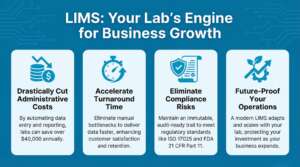
If a technician’s fully burdened cost is $50/hour, that is a savings of $3,350 per month, or $40,200 annually, just on administration. This often covers the subscription cost of the software itself.
Eliminating Investigation Costs
What is the cost of a bad result leaving the lab? Between Root Cause Analysis, re-testing, and reputation damage, a single significant error can cost thousands. By enforcing QC limits at the point of data entry, a LIMS prevents bad data from ever becoming a final report.
For smaller operations worried about the initial investment, review our guide on LIMS for Small Labs to understand how cloud-based models have made ROI achievable for labs of all sizes.
Data Integrity and Compliance Security
In regulated industries—whether you are adhering to ISO 17025 for environmental testing or GMP for manufacturing—leveraging the compliance benefits of LIMS is synonymous with operational success.
The Audit Trail
Regulatory bodies like the FDA and EPA require deep traceability. A LIMS provides an immutable audit trail. Every action—logging a sample, entering a result, modifying a limit—is time-stamped with the user’s ID.
According to FDA 21 CFR Part 11 guidelines, electronic records must be trustworthy and reliable. Wavefront LIMS is designed to support these requirements natively.
Security and Maintenance
Modern lab database software must also be secure against cyber threats.
Hosting your own data on a local server introduces risk.
Wavefront leverages Microsoft Azure’s infrastructure, providing enterprise-grade security and SOC 2 Type II compliance to protect your proprietary data from loss or theft.
Strategic Business Value: Faster Turnaround
Beyond the lab bench, the benefits of LIMS offer strategic value to the business as a whole. In commercial testing, the product you sell is data. The faster you deliver that data, the happier your customer is.
Reducing Turnaround Time
By removing the manual bottlenecks of log-in and reporting, a LIMS significantly compresses turnaround time. Real-time alerts can notify managers of samples approaching their due dates, preventing Service Level Agreement (SLA) breaches.
Enhanced Customer Experience
Modern LIMS solutions, such as Wavefront, offer laboratory customer portals. Instead of calling your lab to ask, “Is my sample done?”, clients can log in, view status, and download reports. This transparency builds trust and reduces the customer service burden on your staff.
Future-Proofing Your Lab with Configurable Workflows
Despite the clear benefits of LIMS, one of the historic fears regarding adoption is rigidity. Labs worry they will be forced to change their unique processes to fit the software. This was true of legacy “hard-coded” systems, but modern technology has shifted the paradigm.
Configuration vs. Customization
Wavefront Software utilizes a “configuration over code” philosophy.
This means Wavefront LIMS is designed to adapt to your laboratory.
You can:
- Add new fields
- Modify workflow steps
- Change report templates
without hiring a software developer.
This capability is crucial for future-proofing. As your lab expands into new markets—perhaps moving from Environmental Testing into Advanced Materials Manufacturing—your LIMS can adapt to the new test methods and specifications immediately.
Scalability
A cloud-based LIMS grows with you. Whether you are adding a single instrument or acquiring a new laboratory site, the infrastructure scales automatically. For labs that require assistance with this growth, Wavefront’s Managed Services ensure that your team is supported by LIMS experts, not just generic IT support.
Conclusion

The benefits of LIMS extend far beyond simple organization. It is a strategic tool that transforms your laboratory from a cost center into a high-efficiency data engine.
By eliminating the risks of sample tracking in Excel, automating tedious workflows, and ensuring rigorous data integrity, a LIMS pays for itself through operational savings and risk mitigation. In an industry where accuracy and speed are paramount, sticking to manual processes is a liability you can no longer afford.
If you are ready to stop managing spreadsheets and start managing your laboratory, the next step is to see the benefits of LIMS in action.
Schedule a No-Obligation Demo with Wavefront Software today and discover how a configurable, secure LIMS can revolutionize your lab’s efficiency.

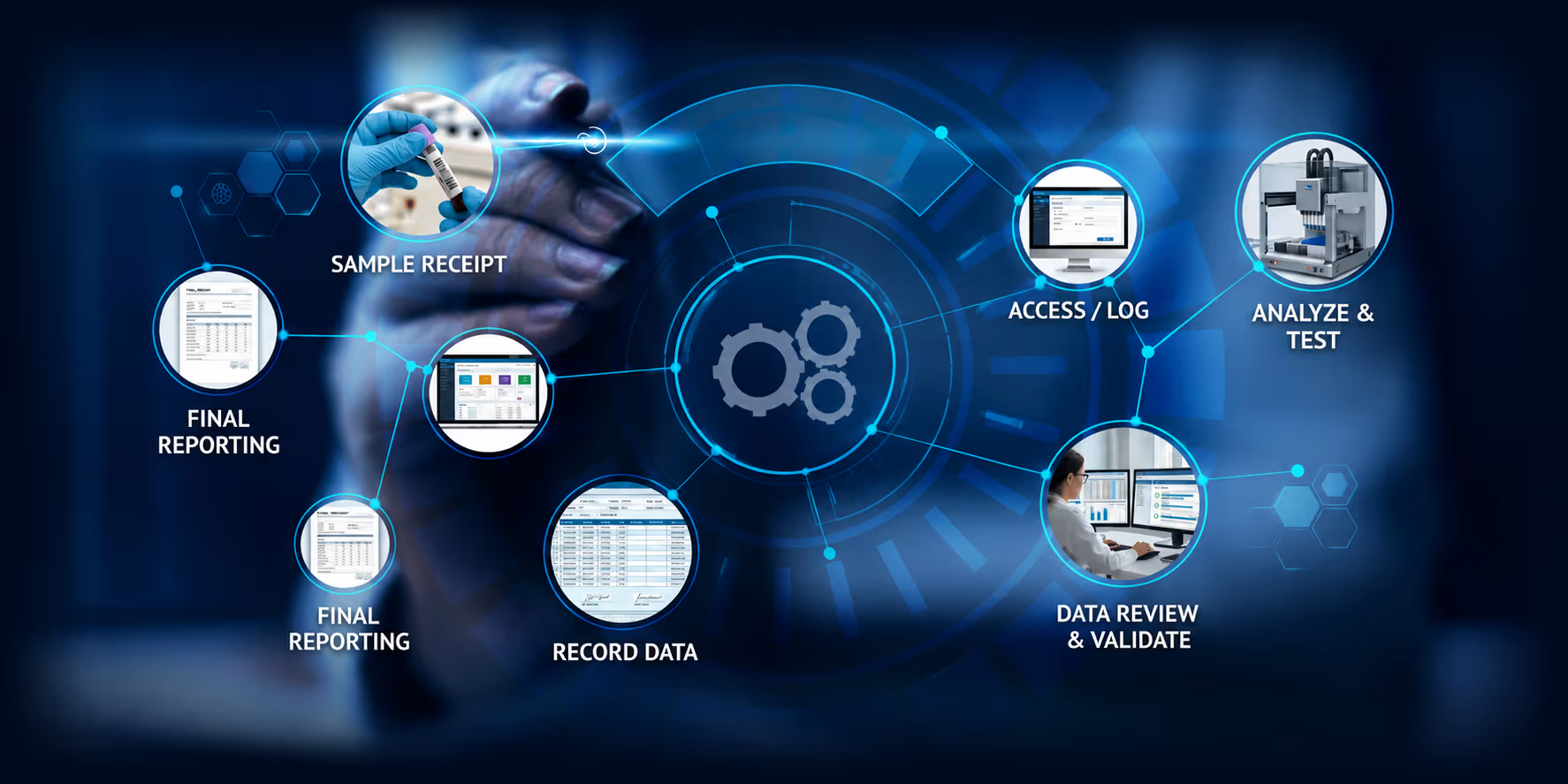
A LIMS workflow helps laboratories automate and standardize the entire sample lifecycle, from sample receipt and testing to approvals and final reporting. Learn how workflow automation improves traceability, reduces manual work, and increases laboratory efficiency.

Struggling with lab errors? Learn how to reduce lab errors using proven strategies like instrument integration, workflow automation, and real-time validation. Improve data accuracy, eliminate manual processes, and streamline your laboratory operations with a modern LIMS.

Small laboratories often struggle with manual processes, believing LIMS software is too expensive. This article explains why a modern LIMS for small labs is essential for efficiency and compliance. Learn how no-code configuration, cloud security, and ROI-focused features can professionalize your lab without the heavy IT burden.
-
Most laboratories start out using Excel to manage samples and workflows, but as they grow, it becomes difficult to maintain a reliable LIMS workflow. Here are five signs your lab may have outgrown spreadsheets and what to do next.