Wavefront LIMS helps manufacturing organizations:
- Track samples from receipt through final approval
- Maintain material, batch, lot, and heat traceability
- Automate testing workflows and approvals
- Capture instrument data electronically
- Generate Certificates of Analysis and customer reports
- Integrate laboratory data with ERP and production systems
LIMS for Process and Discrete Manufacturing
Process Manufacturing
Process manufacturers produce materials using recipes, formulations, or continuous production processes.
Process manufacturing environments commonly include:
- Specialty chemicals
- Advanced materials
- Coatings
- Plastics and polymers
- Food ingredients
- Lubricants
- Composite materials
These laboratories often require:
- Batch genealogy
- Formulation management
- In-process testing
- Finished product testing
- Retained sample management
- Certificate of Analysis generation
Discrete Manufacturing
Discrete manufacturers build individual products or components that require extensive material traceability and production documentation.
Discrete manufacturing environments commonly include:
- Aerospace
- Automotive
- Fasteners
- Metals
- Industrial equipment
- Electronics
Typical laboratory requirements include:
- Incoming material inspection
- Heat lot traceability
- Mechanical testing
- Chemical analysis
- Production approvals
- Finished product verification
- Customer certifications
Wavefront LIMS supports both process and discrete manufacturing through configurable workflows, connected laboratory data, and complete traceability across materials, batches, components, testing, and approvals.
Manufacturing Industries Supported
Common Manufacturing Laboratory Workflows
Manufacturing laboratories often manage complex testing and quality processes across multiple production stages. Wavefront LIMS supports workflows including:
- Raw material and incoming inspection
- In-process and finished-product testing
- Mechanical, chemical, hardness, and other material testing
- Heat treatment and process verification
- Lot release and electronic approvals
- Certificate of Analysis generation
- Retained sample management
- Supplier quality testing
- Customer-specific reporting
By standardizing these workflows, manufacturers reduce manual processes while improving quality, consistency, and traceability.
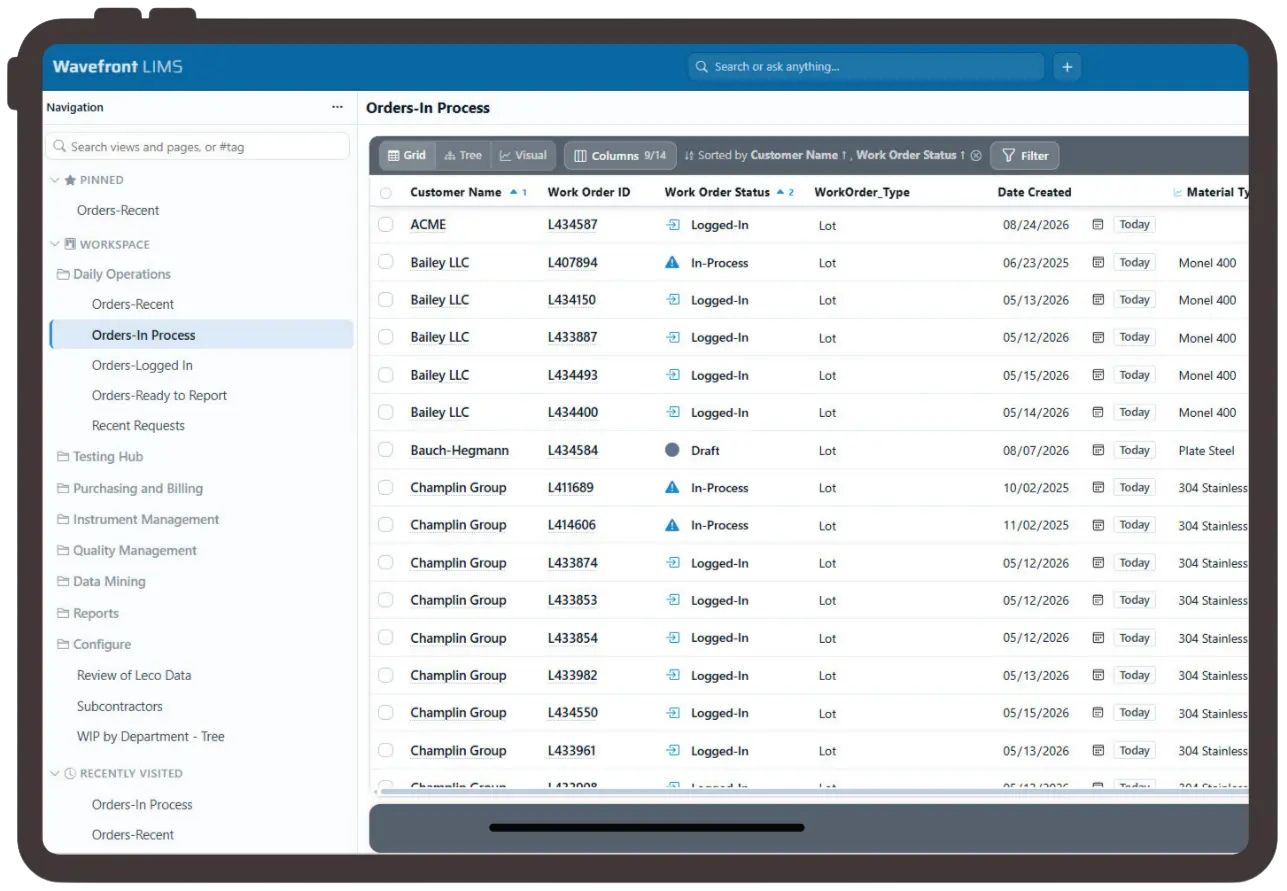
Track every work order by customer, lot, material type, and status, from Draft to Logged-In to In-Process, in one sortable view.
ERP and Production System Integration
Manufacturing laboratories rarely operate as standalone departments. Laboratory information must often be shared with ERP, MES, production planning, inventory, purchasing, and customer management systems.
Wavefront LIMS integrates with ERP and production systems to exchange production orders, sample information, laboratory results, Certificates of Analysis, inventory records, and quality data. This reduces duplicate data entry while improving communication between laboratory and manufacturing operations.
Related links:
A Manufacturing LIMS That Scales With Your Operation
As testing volumes increase, manufacturing laboratories must manage more complex relationships among materials, production batches, specifications, approvals, customer requirements, and historical results. Maintaining these connections is essential for supporting quality, traceability, compliance, and efficient production.
Wavefront LIMS provides a scalable foundation for managing this complexity as your operation grows. By keeping laboratory data connected across testing, approvals, reporting, and production workflows, the system helps laboratories manage higher testing volumes while maintaining visibility, consistency, and traceability.
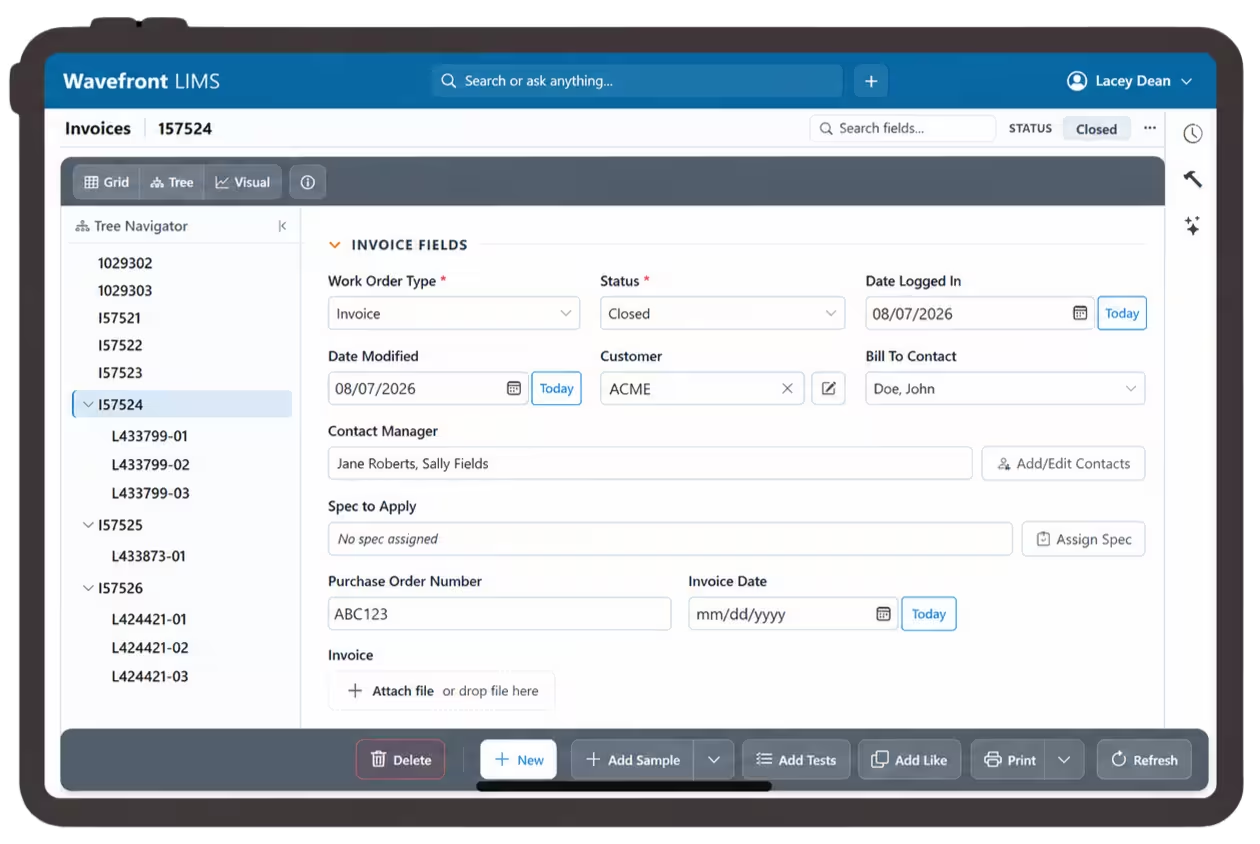
Wavefront LIMS links invoices, purchase orders, and customer contacts directly to the lot samples they cover, keeping lab and business records connected.
Why Manufacturing Teams Choose Wavefront LIMS
Manufacturing laboratories rarely follow a single standardized process. Testing requirements, approval workflows, customer specifications, and production processes vary by industry, product, and organization.
- Configurable laboratory and approval workflows
- Complete material, batch, lot, and sample traceability
- Customer-specific Certificates of Analysis and reports
- Instrument, ERP, and production-system integration
- Multi-site and enterprise laboratory operations
- Scalable workflows for growing testing volumes
Frequently Asked Questions
What is a LIMS for manufacturing?
A manufacturing LIMS is laboratory software that helps manufacturers manage testing, quality control, sample tracking, material traceability, and laboratory workflows throughout production.
What manufacturing industries use LIMS?
LIMS software is widely used by aerospace, automotive, metals, advanced materials, specialty chemicals, food and beverage, electronics, and industrial manufacturing laboratories.
Can a manufacturing LIMS integrate with ERP systems?
Yes. Wavefront LIMS can integrate with ERP, MES, inventory, production planning, and other business systems to exchange production orders, sample information, laboratory results, Certificates of Analysis, and quality data.
What are the essential LIMS features for regulated manufacturing?
Manufacturing laboratories typically require sample tracking, lot traceability, workflow automation, audit trails, electronic signatures, Certificates of Analysis, reporting, instrument integration, and configurable laboratory workflows.
How does LIMS improve traceability?
Wavefront LIMS maintains complete historical records linking samples, materials, production batches, test results, approvals, and certifications, making it easier to investigate quality issues and support customer or regulatory requirements.